Curious about Curiosity?
Key Takeaway
Researchers discovered that curiosity isn’t just a “nice” feeling; it actually feels like an uncomfortable “itch” in the brain that we are driven to scratch. When we finally get the answer we’re looking for, our brain’s reward center lights up. This acts like a “save button” for our memory, which helps us remember that new information.
The Mystery
What we know
Curiosity is a basic biological drive, as fundamental as hunger or thirst (Berlyne, 1954). Back in the 1950s, psychologists proposed that when we encounter something “ambiguous” (blurry or confusing), our brain enters an uncomfortable state of high arousal (Berlyne, 1960). We also know that reducing this uncertainty feels good and helps us learn better (Berlyne, 1966).
What we don’t know
Despite how often we feel curious, we didn’t actually know how the human brain creates this feeling. Does the brain actually treat “not knowing” like a physical pain or a “conflict”? And does getting the answer actually trigger the same reward centers as winning money or eating chocolate? This paper aims to map those specific neural pathways for the first time.
The Setup
Approach
To solve this mystery, researchers put 19 participants into an fMRI scanner and showed them 140 pairs of pictures. The trick was in how the pictures were paired. Sometimes, a participant’s curiosity was “satisfied” (they saw the answer), and sometimes it was “denied” (they were left hanging).
| Tool | Goal |
|---|---|
| fMRI Scanner | To track blood flow and see which brain regions “light up” during curiosity. |
| Blurred Pictures | To induce Perceptual Curiosity (the itch to know). |
| Free-Recall Test | To see if being curious helped them remember the objects later (incidental memory). |
Experiment Design
Researchers used four main conditions (Nicki, 1970). The two most important ones were:
- Satisfied Curiosity (B–C corresponding): A blurred picture followed by the correct clear version.
- Denied Curiosity (B–C unrelated): A blurred picture followed by a different clear picture.
Figure 1 shows the four different scenarios participants experienced in the scanner. Think of it as different ways the researchers triggered and then satiated the curiosity.
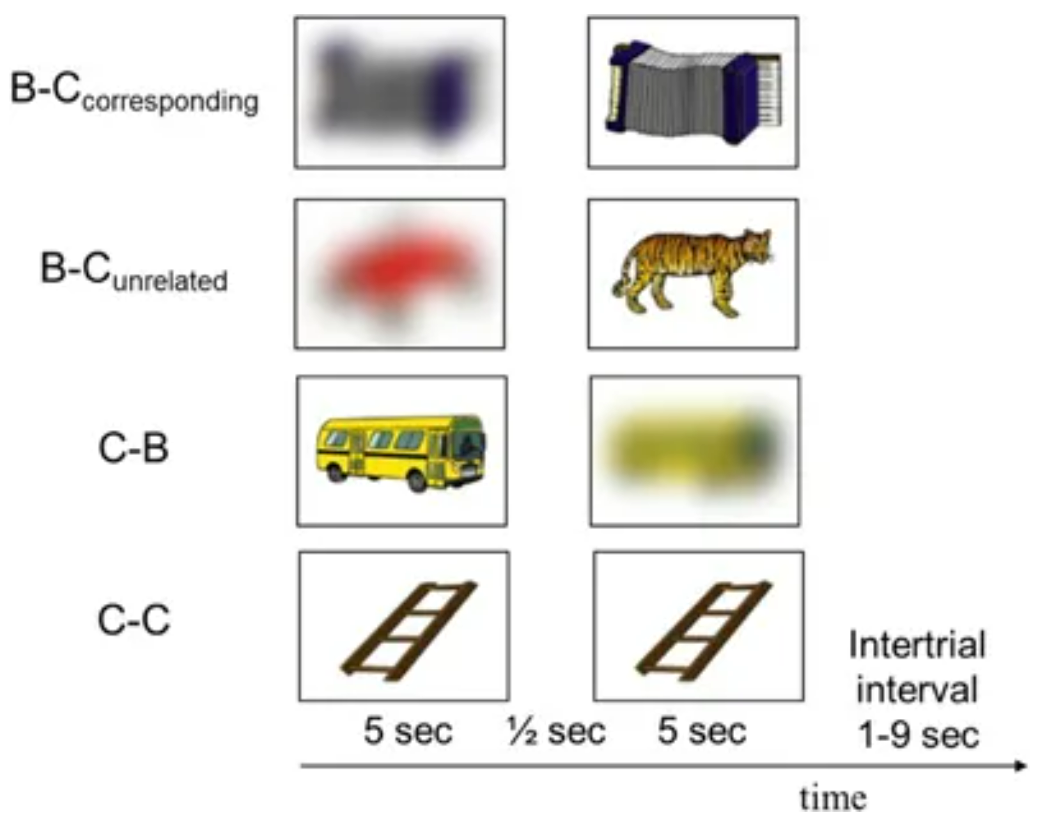
Satisfying the Itch (B–C corresponding): You see a blurry object, your brain tries to guess what it is (the induction of curiosity), and then you see the clear answer (the relief). This is where the “Reward” and “Memory” centers were most active.
The Tease (B–C unrelated): Here, you see a blurry object, but the clear picture that follows is something completely different. Your brain is left hanging, which allowed the researchers to show that simply seeing any clear image isn’t enough. You need a plausible answer to get the reward.
The Baselines (C–B and C–C): These were sanity checks. By starting with clear pictures, the researchers could see what a brain looks like when it isn’t curious, giving them a baseline to compare against the “Curiosity” rounds.
What we expect
The team expected that the Induction of curiosity would activate areas of the brain sensitive to unpleasant feelings (like the ACC and Insula). Conversely, they hypothesized that the Relief of curiosity would activate the brain’s “Reward Center” (the Striatum) and the “Librarian” (the Hippocampus) to save the information (Berlyne, 1954).
The Discovery
The brain treats curiosity like an aversive itch. In their study, Jepma et al. (2012) found that curiosity activates regions associated with conflict and pain, while satiating the curiosity elicits a massive reward signal.
Results
- The “Itch”: When participants saw a blurred picture, the Anterior Cingulate Cortex (ACC) and Anterior Insula (AIC) lit up. These are the same regions that react when you feel physical pain or social rejection (Peyron et al., 2000).
The “Scratch”: Seeing the correct clear picture activated the Striatum. This proves that information itself is a “reward” (O’Doherty, 2004).
The “Save Button”: Satisfying curiosity led to higher activation in the Hippocampus and significantly better scores on the memory test later.
The Horizon
So What?
This study shows that curiosity is more than a thought. It is a biological motivator. By connecting curiosity to the reward system, we see that our brains are literally wired to enjoy learning (Loewenstein, 1994). This suggests that if we want students or employees to remember information, we should first make them curious about it. We have to create the itch before we can offer the scratch.
Reality Check
While these results are exciting, we have to remember this was a small group in a lab setting. The sample size was small (19 people), so we need larger studies to further provide evidence for these patterns across different ages. Also, the study used a passive-viewing task. Participants didn’t have to work to see the clear picture. In real life, curiosity often involves active searching, which often involves different brain region (Voss et al., 2011). Curiosity in the real world might be a bit more complex.
Future Directions
The next step is to explore Epistemic Curiosity, the motivation to learn facts or solve math problems, since these concepts are more complex than viewing blurry pictures. Do we get the same “reward” from learning a new language as we do from seeing a clear photo? Researchers also want to look at how curiosity changes in brains with depression, a condition where the reward system might not fire the same way.
Jargon Decoder
| Term | The “Plain” Definition |
|---|---|
| Anterior Cingulate Cortex (ACC) | The brain’s “conflict alarm.” It switches on when things are confusing or when we make a mistake. |
| Anterior Insula (AIC) | A region that processes internal feelings. It’s sensitive to that “tingly” feeling of arousal or uncertainty. |
| Hippocampus | The brain’s “librarian,” essential for forming and storing new memories. |
| Striatum | Part of the “Reward Center.” It releases “feel-good” chemicals when we solve a puzzle or get a prize. |
| Neural Correlates | Brain activities that happen at the exact same time as a specific thought or feeling. |
| Perceptual Curiosity | The “itch” you feel when you see a blurry shape and need to know what it is. |
| Arousal | A state of being reactive and alert. In this study, it’s that restless feeling you get when you’re stumped. |
| Aversive State | A scientific way of saying “a feeling we want to avoid,” like hunger or unresolved curiosity. |
| Ambiguity | When something could mean two different things. The brain dislikes this and works hard to pick one option. |
| fMRI | A scanner that detects blood flow to see which brain parts “light up” during a task. |
| Gaussian Smoothing | The digital “blur” used on the photos, like looking through a foggy shower door. |
| Low-Pass Filter | A technical blur that keeps big shapes but blocks sharp details (the “edges”). |
| Incidental Memory | Learning that happens “by accident” without you actively trying to memorize anything. |
| Entropy | A mathematical measure of uncertainty. High entropy = lots of possible guesses; Low entropy = clear answer. |
| Alpha-Wave Blocking | The brain switching from “idle/relax” mode to “focus” mode. |
| Desynchronization | When neurons stop “firing” together and start working individually on a complex problem. |
| B–C corresponding | When a Blurred photo is followed by its Correct clear version. |
| B–C unrelated | When a Blurred photo is followed by a Clear photo of something else. |
| Pseudorandom | Something that looks random but was actually carefully planned for a fair mix. |
The Source
This report is a summary of the research conducted by Jepma et al. (2012).
Original Title: “Neural mechanisms underlying the induction and relief of perceptual curiosity”
Authors: Marieke Jepma, Rinus G. Verdonschot, Henk van Steenbergen, Serge A. R. B. Rombouts, and Sander Nieuwenhuis
Published: 2012, Frontiers in Behavioral Neuroscience
Affiliation: Leiden University, The Netherlands